From Portuguese barrels and Basque rivermouths to Irish slabs and Canary Island reefs — the waves that make Europe a surf continent in its own right.
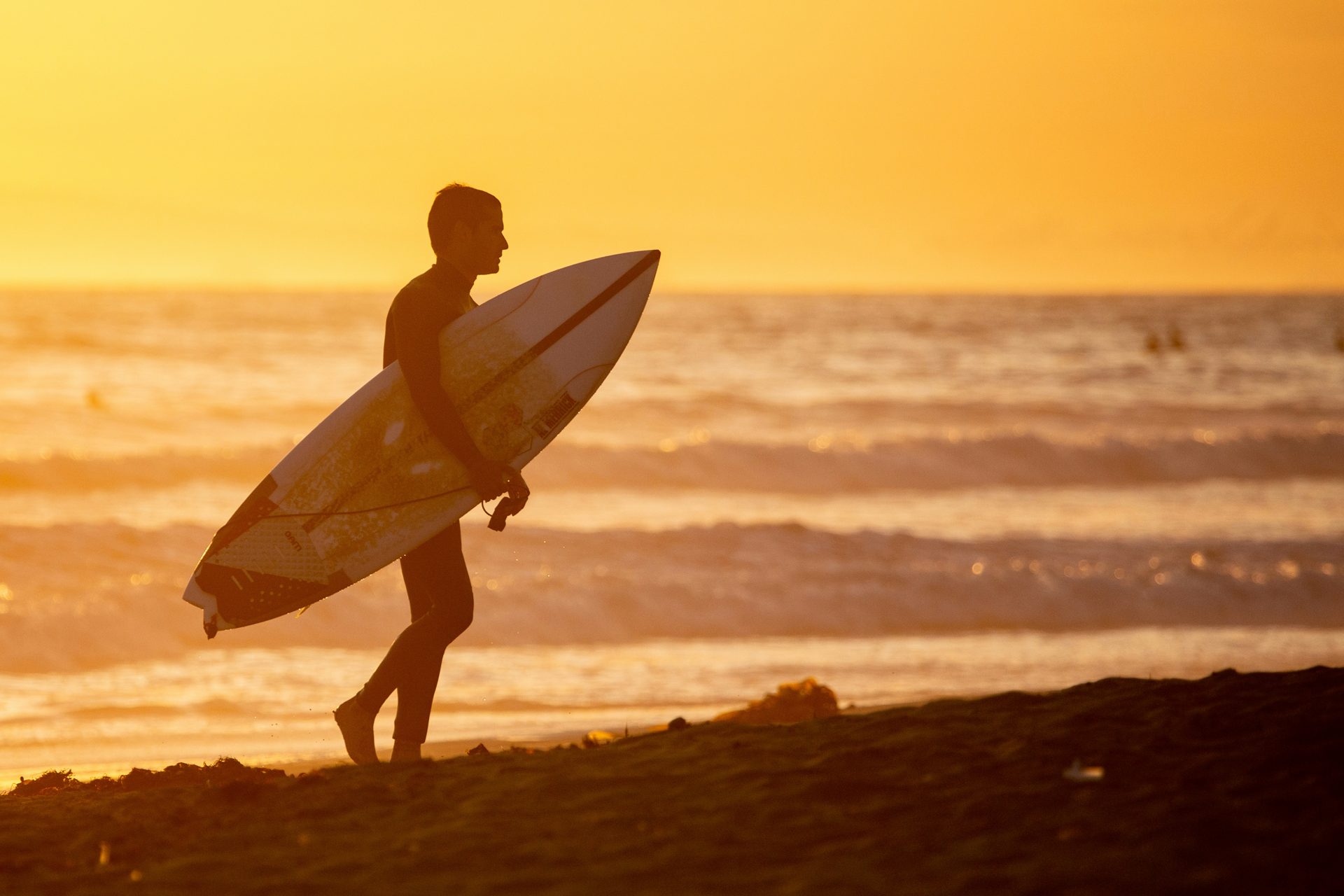
Surfer silhouette holding a board at sunset
Every lineup has its own language — here is the dictionary. Photo: Bob Oh / Unsplash
Surfing has its own vocabulary, and knowing it makes the sport easier to learn and the lineup easier to read. Surf slang combines technical surfing terminology with the informal words and expressions surfers use to describe waves, maneuvers, surfboards, conditions and life in the lineup.
Some essential surf terms: a set is a group of larger waves; offshore wind blows from land to sea and helps create clean conditions; a barrel (or tube) is the hollow part of a breaking wave; your stance is regular (left foot forward) or goofy (right foot forward); a lineup is where surfers wait for waves; and dropping in is taking a wave that someone else already has priority on. This surf slang glossary covers the essential terms from A to Z.
Surf slang isn't just for sounding cool — much of it is practical shorthand for conditions, equipment and safety. Some expressions describe waves or maneuvers, while others come directly from surf culture and the way surfers talk to each other in and out of the water.
Knowing what "offshore and clean with a solid set every few minutes" means tells you instantly whether to paddle out. This surf slang A to Z covers the terms you'll actually hear, from your first lesson to your hundredth session. For related concepts such as break types and right of way, see our guides to types of surf breaks and surf etiquette.
A-frame — A peak that breaks both left and right, offering waves in two directions from one point.
Aerial (air) — A maneuver where the surfer launches above the wave and lands back on the face or in the whitewater. Also called an air.
Aggro — Short for aggressive. Used to describe a surfer, lineup or situation that feels hostile, territorial or overly competitive.
Backdoor — To enter a barrel from behind the peak, taking off on the opposite side and riding through the tube.
Backside — Surfing with your back to the wave, the opposite of frontside. It depends on your stance and the wave's direction.
Bail — To jump or fall off your surfboard intentionally, usually to avoid a collision or difficult section. Bailing near other surfers can be dangerous, so keep control of your board whenever possible.
Barrel (tube) — The hollow part of a breaking wave, where the lip throws over and creates a rideable tube. The pinnacle of surfing for many.
Beach break — A wave that breaks over a sandy bottom. Generally the most beginner-friendly type of break.
Bomb — An unusually large wave or set, well above the average size on the day.
Bottom turn — The turn made at the bottom of the wave after the takeoff, setting up speed and direction for the next maneuver. One of the foundations of good surfing.
Boost — To launch off the lip and get airborne, usually while performing an aerial maneuver.
Brah — A surf-culture variation of "bro", used informally between friends or fellow surfers.
Carve — A powerful, drawn-out turn on the face of the wave.
Channel — A deeper area where waves don't break, used by surfers to paddle out without fighting the whitewater.
Chop — Small, uneven bumps on the water surface, usually caused by wind, that make surf conditions rougher and less clean.
Closeout — A wave that breaks all at once along its length rather than peeling, making it difficult or impossible to ride for long.
Crew — The group of surfers you regularly surf, travel or hang out with.
Drop in — To take off on a wave that another surfer already has priority on. The biggest breach of surf etiquette.
Duck dive — Pushing your board underwater to get under an oncoming broken wave while paddling out, typically used on shortboards.
Gnarly — Surf slang for something extreme, intense or impressive. A gnarly wave might be big, heavy or difficult to surf.
Goofy — A stance with your right foot forward. The opposite of regular.
Green wave — An unbroken, open wave face, as opposed to whitewater. Learning to catch and ride green waves is a key step beyond the beginner stage.
Grom (grommet) — A young surfer, usually a kid or teenager, who spends as much time in the water as possible. Often used affectionately within surf culture.
Groundswell — Swell generated by distant storms, usually producing more organized and powerful waves than local wind swell.
Kook — A surfer who lacks experience, awareness or respect for surf etiquette. The term often refers more to behavior than skill: even an experienced surfer can act like a kook.
Lineup — The area where surfers sit and wait to catch waves, just outside where the waves break.
Lip — The top edge of a breaking wave as it pitches forward.
Offshore — Wind blowing from the land out to sea, helping hold up the wave face and create cleaner, better-shaped conditions.
Onshore — Wind blowing from the sea toward land, which tends to make waves messy and crumbly.
Outside — The area farthest from shore, where the biggest waves break. "Outside!" is also a shout used to warn surfers of a big incoming set.
Peak — The highest part of a wave where it first breaks; the surfer closest to it generally has right of way.
Point break — A wave that wraps around a headland or point and peels in one direction, often offering long rides.
Pop-up — The move from lying on the surfboard to standing in one motion. The foundational beginner skill.
Potato chip — Surf slang for a very thin, lightweight performance shortboard, usually designed for responsive surfing rather than stability or easy paddling.
Rails — The edges of a surfboard running from nose to tail. Their shape affects how the board turns, holds the wave face and performs in different conditions.
Reef break — A wave breaking over coral or rock. Usually consistent and powerful, but less forgiving than a sandy bottom.
Regular (natural) — A stance with your left foot forward. The opposite of goofy.
Rip current — A channel of water flowing away from shore and back out to sea. A key ocean hazard to understand and respect.
Set — A group of larger waves arriving together, usually with calmer water between sets.
Shoulder — The unbroken part of the wave ahead of the breaking section, where you ride.
Shred — To surf with speed, skill and powerful turns. "Shredding" means surfing particularly well.
Snake — To paddle around another surfer to unfairly claim priority. Bad surf etiquette.
Stoked — Extremely excited or happy, especially about surfing, good waves or an upcoming session. "Stoke" is the feeling itself and one of the most recognizable words in surf culture.
Stick — Surf slang for a surfboard. "Nice stick" simply means "nice board."
Swell — Waves traveling across the ocean before they break, usually described by height, period and direction.
Takeoff — The moment of catching the wave and getting to your feet.
Turtle roll — Rolling upside down with your board to get under an incoming wave, typically used on longboards instead of a duck dive.
Whitewater (soup) — The foam left after a wave breaks. This is where most beginners first learn to catch waves and practice their pop-up.
Wipeout — Falling off, or being knocked off, your board. A universal and unavoidable part of surfing.
Yard sale — A wipeout where your board and gear end up scattered around you, as if everything had been laid out for sale in a yard.
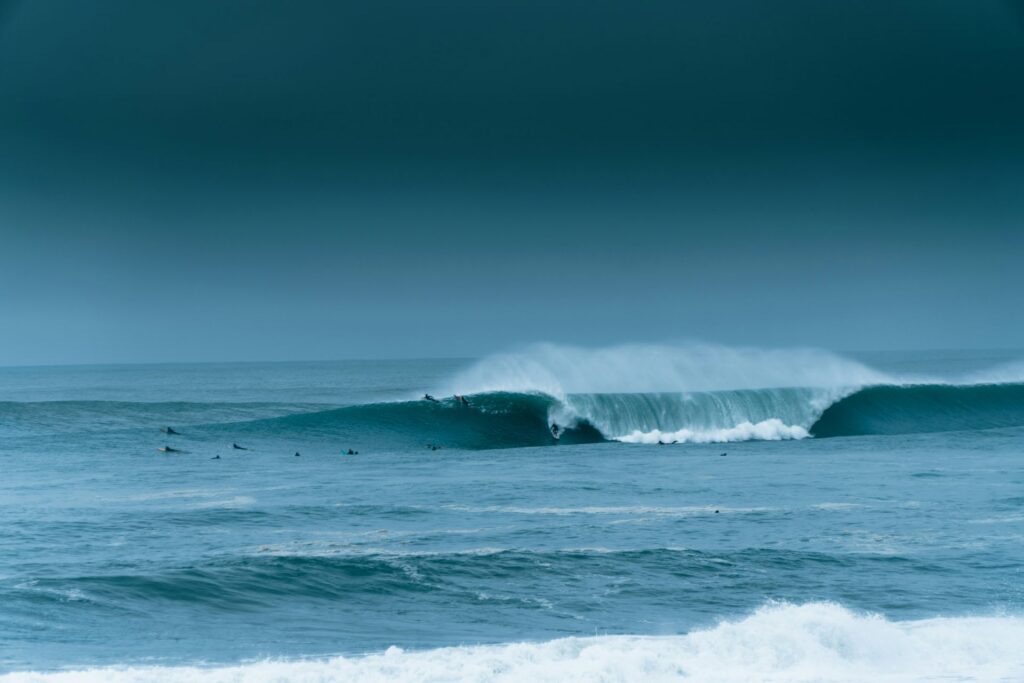
Clean wave with offshore spray
Offshore wind grooming a clean, rideable face. Photo: Jarno Colijn / Unsplash
Now that the surf slang and vocabulary make sense, the conditions described on every Wave Safari spot page will read like plain English: break type, wave direction, ideal swell and wind, best tide and the crowd to expect. Understanding surfing terminology and the language of the lineup is the first step toward reading the ocean.
Surf slang is the informal vocabulary surfers use to talk about waves, surfboards, maneuvers, conditions and surf culture. It includes technical terms like "barrel" and "bottom turn" as well as cultural expressions like "stoked", "grom", "kook" and "gnarly".
Offshore describes wind blowing from the land out to sea. It helps hold up the wave face and create cleaner, better-shaped conditions, which is why offshore winds are generally prized by surfers. Onshore wind, blowing from sea to land, tends to do the opposite and makes waves messier.
A set is a group of larger waves that arrive together, usually with a lull of calmer water between sets. Surfers wait in the lineup and time their position to catch the better waves in each set.
Regular (or natural) means you surf with your left foot forward; goofy means you surf with your right foot forward. Neither is better — it's simply whichever stance feels natural, much like being right- or left-handed.
A barrel, also called a tube, is the hollow space formed when the lip of a wave throws over the face. Riding inside it is one of the most sought-after experiences in surfing and requires the right kind of hollow, powerful wave.
Dropping in means taking off on a wave that another surfer already has priority on, cutting across their path. It's dangerous and one of the most serious breaches of surf etiquette.
Stoked means excited, happy or enthusiastic. Surfers use it to describe the feeling of catching great waves, having a good session or simply being in the water. The feeling itself is often called "stoke".
A kook is someone who shows poor awareness, behavior or surf etiquette in the water. It can describe an inexperienced surfer, but the term is more about how someone behaves than how well they surf.
Ready to read a real lineup? Explore surf spots on Wave Safari, where conditions, waves and breaks are described using the surf terminology you now understand.
Learn the words, then go live them. The ocean is fluent, and now so are you.
From Portuguese barrels and Basque rivermouths to Irish slabs and Canary Island reefs — the waves that make Europe a surf continent in its own right.
Great waves don't have to cost a fortune. Seven destinations where your money buys more time in the water.
From a vague urge to chase waves to a booked trip that actually delivers. Here's the order to do it in.
The right wetsuit keeps you in the water longer. Here's exactly what to wear, by degree.
The ocean has rules nobody prints on a sign. Learn them and you'll be welcome anywhere.
Everything you need to bring for your next surf trip, including the small surf trip essentials first-timers always forget.
Why some waves are gentle and others are heavy comes down to what's under the water. Here's how to read them.
What beginner, intermediate and advanced really mean in the water — and how to know which one you are.
Why timing matters more than destination — and how to find good waves somewhere in the world every month.
Not a hotel, not quite a hostel: is where surf trips actually happen. Here's what makes one.