From Portuguese barrels and Basque rivermouths to Irish slabs and Canary Island reefs — the waves that make Europe a surf continent in its own right.

Surfers waiting together in the lineup. A shared lineup runs on respect, not signs. Photo: Buddy An / Unsplash
Surf etiquette is the set of unwritten rules that keep a lineup safe and fair. The core rules:
Following proper surfing etiquette keeps everyone safe and helps you feel welcome in lineups wherever you surf.
You can be the best surfer in the water and still be the most disliked if you ignore basic surf etiquette. The lineup is a shared space with no lifeguard directing traffic, so it runs on a code that every surfer is expected to know. In a crowded lineup, courtesy, awareness and respect matter just as much as surfing ability.
The rules exist for two reasons: safety, because boards and surfers moving fast in close quarters can cause serious injuries, and fairness, because good wave sharing means everyone gets a chance. Learn them before you paddle out and you'll be respected on any coast in the world.
The most important rule. The surfer closest to the breaking part of the wave — the wave peak — generally has right of way. When two surfers are paddling for the same wave, the surfer on the inside — closest to the peak — generally has priority. Being first to your feet doesn't automatically give you right of way if another surfer is already deeper on the wave. This single rule prevents most collisions and arguments.
On a wave that can break both ways, communicate clearly. A call of "Left!" or "Right!" tells other surfers which direction you're taking and can prevent confusion or collisions.
Dropping in means taking off on a wave when another surfer already has priority, cutting across their line. It's the cardinal sin of surfing — dangerous and deeply frustrating. If a surfer is up and riding toward you, do not take the wave, even if you're in position. When in doubt, don't go.
If you accidentally drop in (it happens), apologize and pull off the wave. A quick "Sorry, my bad" and a genuine apology can defuse almost any tension. Pretending it didn't happen does the opposite.
Snaking is repeatedly paddling around someone to position yourself closer to the peak and claim priority. It exploits the right-of-way rule, but it's selfish and quickly earns you a bad reputation. Don't snake and don't hog the waves: in a crowded lineup, respect the informal pecking order and give other surfers their turn.
When paddling out or paddling back out after a wave, use the channel — the calmer area where waves aren't breaking — whenever possible and avoid paddling straight through the takeoff zone where people are riding. If a surfer is riding toward you, paddle toward the whitewater and behind the rider whenever it is safe to do so, rather than toward the open face and into their line.
Never ditch your board to dive under a wave if anyone is behind you — a loose board on a leash is a missile. Learn to keep control of your board while duck diving or turtle rolling, especially in a crowded lineup.
Stay aware of what's happening around you, especially in a crowded lineup. Watch for surfers, boards, currents and changing surf conditions. If someone appears to be in trouble, alert a lifeguard when available or help if you can do so safely.
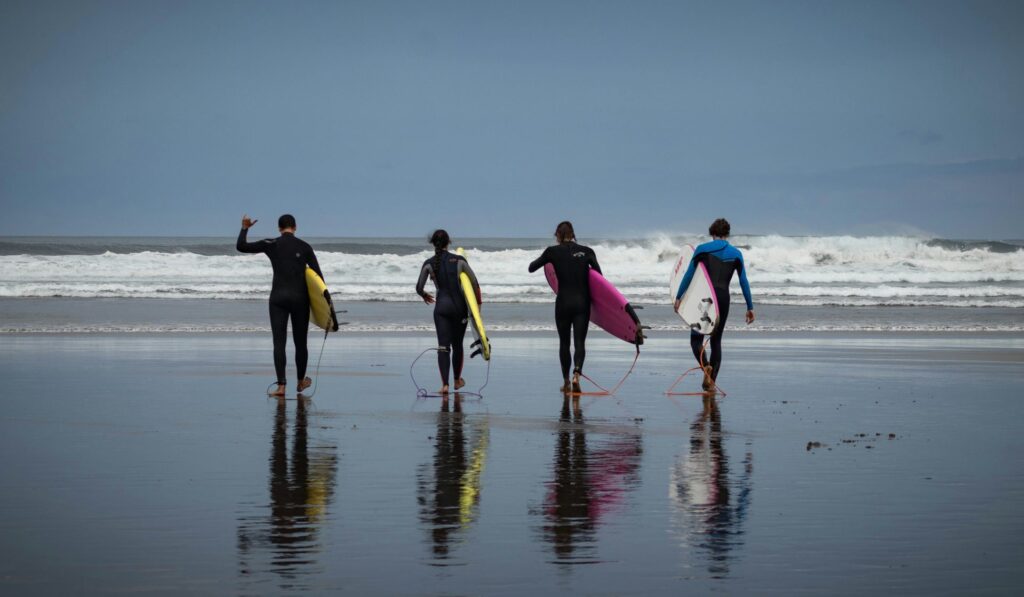
Group of surfers walking into the water at sunset. Wait your turn, share the waves, and the vibe stays warm. Photo: Eduardo Madrid / Unsplash
When you travel to surf, you're a guest at someone's home break. Be humble, don't paddle straight to the peak and start taking every wave, and respect the locals and the existing lineup. "Localism" — hostility toward visitors — exists in places, and while it's never an excuse for aggression, a respectful, low-key attitude goes a long way toward helping you fit into the lineup. Smile, share waves and don't act entitled.
Don't paddle out at a heavy, expert-level surf spot if it's beyond your ability. Beyond the danger to yourself, a surfer out of their depth is a hazard to others and disrupts the lineup. Beginners should pick the right location for their ability and check the surf forecast before paddling out. Conditions can change quickly, and a safe spot one day may be completely unsuitable the next. Choose surf spots that match your level — every spot on Wave Safari is tagged so you can choose appropriately.
Take your rubbish home, use reef-safe sunscreen, don't trample dunes or reefs, and leave the place better than you found it. Surfers are stewards of the coast, and respecting the ocean and beach is an essential part of surf culture worldwide.
Right of way: generally, the surfer closest to the breaking part of the wave — the peak — has priority. If someone is already riding or is deeper than you, the wave is theirs and you must not drop in. This one rule prevents most collisions and conflict.
Dropping in is taking off on a wave that another surfer already has priority on, cutting across their path. It's dangerous and considered the biggest breach of surf etiquette. If a surfer is up and riding toward you, don't take the wave.
Localism is territorial behavior by local surfers toward visitors, ranging from cold attitudes to outright hostility. It's never an excuse for aggression, but you can reduce friction by being respectful, humble and patient at unfamiliar breaks, and by not paddling straight to the peak and taking every wave.
Use the channel where waves aren't breaking, and avoid the takeoff zone. If you find yourself in a rider's path, move toward the whitewater and behind them when it's safe to do so, avoiding the open face they're riding toward.
No, as long as you show respect: wait your turn, don't take every wave, follow right of way, and keep a humble, friendly attitude. Most lineups welcome respectful visitors. Choosing spots that match your level also helps.
Choose a surf spot that matches your ability, respect the lineup, and you'll have a safer, more enjoyable session. Explore spots by skill level on Wave Safari and paddle out with confidence.
Know the code, share the waves, respect the place. Do that and you're welcome anywhere on earth.
From Portuguese barrels and Basque rivermouths to Irish slabs and Canary Island reefs — the waves that make Europe a surf continent in its own right.
Great waves don't have to cost a fortune. Seven destinations where your money buys more time in the water.
Barrel, offshore, goofy, set — decode the language of the lineup so you sound like you belong
From a vague urge to chase waves to a booked trip that actually delivers. Here's the order to do it in.
The right wetsuit keeps you in the water longer. Here's exactly what to wear, by degree.
Everything you need to bring for your next surf trip, including the small surf trip essentials first-timers always forget.
Why some waves are gentle and others are heavy comes down to what's under the water. Here's how to read them.
What beginner, intermediate and advanced really mean in the water — and how to know which one you are.
Why timing matters more than destination — and how to find good waves somewhere in the world every month.
Not a hotel, not quite a hostel: is where surf trips actually happen. Here's what makes one.