From Portuguese barrels and Basque rivermouths to Irish slabs and Canary Island reefs — the waves that make Europe a surf continent in its own right.

Woman carrying a longboard on the beach Travel light: board, suit, sun cream and not much else. Photo: Digital Reach A / Unsplash
The ultimate surf trip packing list can be divided into four groups: surf gear (surfboard or board bag, leash, surf wax or traction pads, fins and a ding-repair kit), exposure protection (a wetsuit suited to the water temperature, rashguard, reef-safe sunscreen and surf hat), travel and health essentials (travel insurance that covers surfing, a first aid kit and ear plugs), and the easy-to-forget extras (a dry bag, spare leash and small board-repair kit).
What you need to pack depends on your destination, the season, the expected surf conditions and whether your accommodation provides boards and other surf gear.
The perfect surf trip packing list for Iceland and the Maldives might have only half their items in common. Before you pack, check two things: the water temperature, which determines whether you need to pack a wetsuit and what thickness you need, and whether your surf house or surf camp provides boards and surf gear. Once you know those, the list below covers everything else. On Wave Safari, each destination lists its season and water temperatures, and each surf house shows whether boards and wetsuits are included.
Renting boards locally can be smarter than flying with your own: you can avoid airline board fees and luggage hassles, reduce the risk of damage and try different board shapes. Bring your own only if you have a board you can't surf without.
Water temperature, not air temperature, determines which wetsuit you need. Our wetsuit thickness guide gives exact recommendations, but the short version: for a tropical surf trip, board shorts or a swimsuit may be enough; in temperate water, you'll typically need a 3/2mm wetsuit, while colder surf spots may call for a 4/3mm suit, booties and sometimes a hood. Whatever the temperature, UV protection is non-negotiable, both in the water and when you need a break from the sun between sessions.
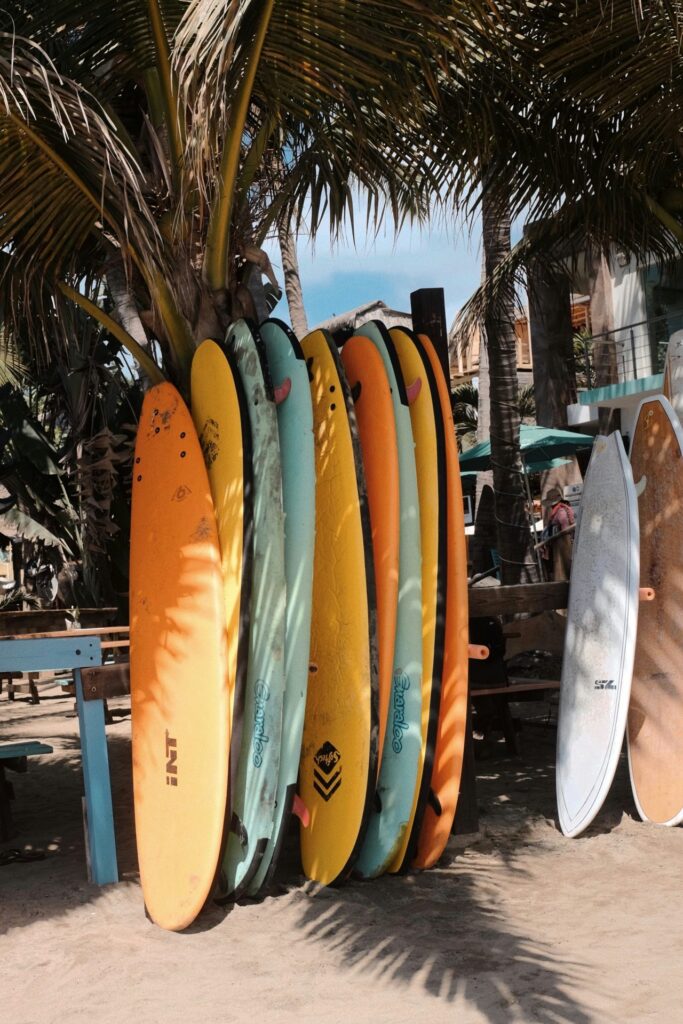
Colorful quiver of surfboards. Bring the right board — or rent one when you land. Photo: Alice Kotlyarenko / Unsplash
Experienced surf travelers swear by a few small items that punch above their weight:
Resist overpacking. If your surf house provides boards and wetsuits, leave yours behind. You rarely need more than a few quick-dry outfits, because you'll live in boardshorts or a wetsuit. Heavy books, multiple pairs of shoes and "just in case" gear can stay at home. The lighter you travel, the easier it is to chase waves.
Surf equipment (board or rental plan, leash, wax, fins, repair kit), exposure protection (wetsuit for the water temperature, rash vest, reef-safe sunscreen, reef boots), travel and health items (surfing-friendly insurance, first aid, ear plugs) and easy-to-forget extras like a dry bag and spare leash. Adjust to the destination, season and whether gear is provided.
Renting is often the smarter choice: you avoid airline board fees and damage risk, and you can try different shapes. Bring your own only if you have a board you really can't surf without, and pack it in a padded board bag.
It depends on the water temperature, not the air. Below about 20°C you'll want a wetsuit, with thickness increasing as the water gets colder. In the tropics, boardshorts or a swimsuit and a rash vest are usually enough. Many surf houses rent wetsuits if you'd rather not pack one.
Yes, and check that it explicitly covers surfing — many standard policies exclude it. Surfing carries a real injury risk from reef, your own board and currents, and medical care abroad can be expensive.
Commonly a dry bag, reef-safe sunscreen, ear plugs, a spare leash and surfing-specific travel insurance. These small items prevent the most common surf-trip headaches.
Before going on a surf trip, check the season, water temperature and surf conditions at your destination. Explore Wave Safari destination pages to find the best surf spots and see which surf houses include boards, wetsuits and other surf gear.
Pack light, protect your skin, insure your trip. Then go get wet.
From Portuguese barrels and Basque rivermouths to Irish slabs and Canary Island reefs — the waves that make Europe a surf continent in its own right.
Great waves don't have to cost a fortune. Seven destinations where your money buys more time in the water.
Barrel, offshore, goofy, set — decode the language of the lineup so you sound like you belong
From a vague urge to chase waves to a booked trip that actually delivers. Here's the order to do it in.
The right wetsuit keeps you in the water longer. Here's exactly what to wear, by degree.
The ocean has rules nobody prints on a sign. Learn them and you'll be welcome anywhere.
Why some waves are gentle and others are heavy comes down to what's under the water. Here's how to read them.
What beginner, intermediate and advanced really mean in the water — and how to know which one you are.
Why timing matters more than destination — and how to find good waves somewhere in the world every month.
Not a hotel, not quite a hostel: is where surf trips actually happen. Here's what makes one.